
 I grew up in San Diego, a city where the military was never distant.
Navy ships moved through the harbor. Marines traveled north toward Camp Pendleton. Shipyards, bases, laboratories, and military families were part of the city’s daily rhythm.
That world stayed with me.
I began as a journalist and spent more than thirty-five years reporting, editing, and writing about the military, public affairs, politics, technology, and the communities affected by them.
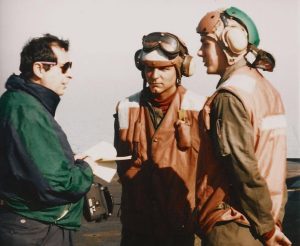
I walked the decks of warships, visited military commands, spoke with enlisted personnel and senior officers, and covered the gap that often exists between official statements and the realities experienced by the people carrying out the mission.
I also watched warfare change.
Maps and grease pencils gave way to satellites, networks, precision weapons, drones, cyber operations, and increasingly autonomous systems. Capabilities that once seemed futuristic became routine.
That evolution eventually led me to fiction.
From Journalism to The Whitlock Protocol
Journalism asks what happened.
Fiction allows a writer to ask what might happen next.
The Whitlock Protocol grew from years of watching military technology advance faster than public understanding. Artificial intelligence, autonomous drones, cloud computing, cyber warfare, distributed networks, and machine learning are no longer theoretical ideas.
They are already changing the battlefield.
The novel takes those technologies and extends them into the near future.
It is fiction, but it is grounded in real places, real military organizations, emerging capabilities, and strategic questions that governments and armed forces are confronting now.
San Diego became the natural setting.
The city’s Navy and Marine Corps presence, defense laboratories, universities, shipyards, technology companies, and neighborhoods all exist beside one another. In the novel, they are not background scenery.
They are part of the story.
The Human Side of War
Military thrillers often focus on hardware.
Ships. Aircraft. Weapons. Surveillance systems.
Those things matter, but they are not the story by themselves.
The real story is always about people.
The sailor who has to act before all the facts are known.
The commander who must decide whether the machine is right.
The family waiting at home.
The neighborhood caught between national strategy and immediate danger.
The journalist trying to separate truth from the version released to the public.
Those are the people I wanted at the center of The Whitlock Protocol.
Technology may drive the crisis.
Human judgment determines what happens next.
Journalism and Public Service
Over the course of my career, I worked as a reporter, editor, commentator, and publisher. My reporting included military affairs, public policy, politics, technology, and the Latino community.
I also served in leadership roles with Military Reporters & Editors and wrote the Military Reporters Stylebook and Reference Guide, created to help journalists report more accurately about the armed forces.
My work has always been guided by the same principle:
Get the facts right, understand the people involved, and never confuse official language with the whole story.
That principle followed me into fiction.
The novel is the product of a lifetime spent in journalism, reading military history, technology, and the people who live with the consequences of decisions made far above them.
It began with a question:
What happens when a weapon no longer needs permission to learn?
That question became The Whitlock Protocol.